What Is Suzani Embroidery? And Why the People Who Make It Matter as Much as the Craft
Suzani embroidery is one of the most striking textile traditions in the world — and somewhere in a workshop or a home in Jaipur right now, someone is stitching it by hand.
Not a machine. Not an algorithm. A person — most likely a woman — sitting with a needle and thread, working through a pattern that her mother probably knew, and her grandmother before that. She is making something beautiful. And that work is paying her rent, buying her children's school supplies, and giving her a skill that belongs entirely to her.
That is the story we want to tell here. Not just what suzani embroidery is — though we will cover that — but why the people behind it matter every bit as much as the craft itself.
What Is Suzani Embroidery?

The word suzani comes from the Persian suzan, meaning needle. Suzani is a form of hand embroidery that originated in Central Asia — in regions that are now Uzbekistan, Tajikistan, and Kazakhstan — where it was traditionally made by brides and their families as part of a wedding dowry. Dense floral motifs, swirling medallions, pomegranates, vines — all stitched by hand in silk or cotton thread onto a base fabric, layer by layer, over months or years.
The craft travelled across trade routes over centuries, absorbed into the textile traditions of South Asia and eventually finding a home in the workshops of Rajasthan — particularly around Jaipur and the surrounding regions — where embroidery has been a cornerstone of the local economy for generations.
Today, suzani embroidery is recognised globally as a luxury craft. But in Jaipur's homes and workshops, it is also something far more immediate than that. It is how hundreds of families pay their bills.
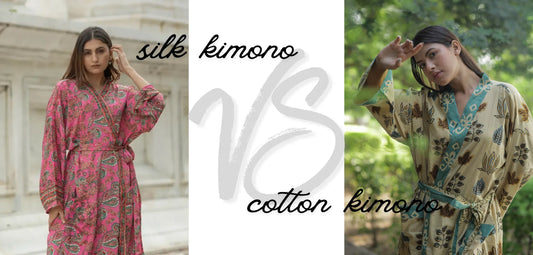
Also Read - Cotton Kimono Robe vs Silk Kimono Robe — Which One Is Right for You?
The Artisans Behind Every Eastern Loom Suzani Piece

Eastern Loom works with hundreds of artisans across Jaipur and the neighbouring regions of Rajasthan. Some work in small shared workshops. Others work from home — embroidering at a table in the corner of a room where their children play nearby, or stitching in the early morning hours before the rest of the household wakes up.
Many of them are women.
For these women, suzani embroidery is not a hobby or a side income. It is their primary contribution to their household — often the most stable and consistent income in the family. It funds school fees, covers medical expenses, and gives them something that paid factory work rarely does: the ability to work on their own terms, at their own pace, from a space they control.
The craft also gives them standing. In communities where women's economic participation has historically been limited, being a skilled embroiderer carries real respect. It is a specialism that takes years to develop and cannot be easily replaced. When a woman in Jaipur's artisan communities says she does suzani work, she is saying something about who she is — not just what she does.
What the Work Actually Looks Like

To understand why this matters, it helps to understand what actually goes into a single suzani-embroidered jacket.
It starts with the base fabric — cotton or velvet, cut and prepared to the pattern. Then an artisan transfers the design outline onto the cloth by hand, mapping out where each floral cluster, vine, and medallion will sit across the surface.
Then the embroidery begins. The most common technique used in Jaipur suzani work is a combination of chain stitch and a form of couching, where threads are laid along the design outline and secured with small stitches over the top, building the pattern up in dense, slightly raised layers. Silk thread gives the finished work its characteristic sheen. Cotton thread produces a softer, more matte result.
This is not fast work. A single jacket panel can take days. A fully embroidered piece — with dense motifs across the front, back, and sleeves — represents many hours of concentrated, skilled labour. The artisan who makes it is not paid by the hour. They are paid for the quality and completeness of what they produce, which means there is no incentive to rush and every incentive to do it properly.
When Eastern Loom commits to paying fairly for that work — not squeezing the price to hit a margin target — it means the artisan is compensated in a way that reflects the actual skill and time involved. That is what we mean when we talk about supporting artisans. Not a percentage donated to a fund somewhere. A fair price, paid directly, for work that deserves it.
Why Fair Wages for Craft Work Matter
There is a version of the handmade fashion story that gets told a lot, and it goes something like this: artisans are passionate about their craft, they love what they do, and the work itself is its own reward.
That story is not wrong exactly. The artisans we work with are skilled, and most of them take genuine pride in their work. But pride does not pay school fees. Passion does not cover medical bills. And the idea that craftspeople should accept low wages in exchange for doing meaningful work is one of the ways the fashion industry has historically underpaid the people at the bottom of its supply chain.
Eastern Loom's position is straightforward: good work deserves fair pay. The hundreds of artisan families in Jaipur and the surrounding regions who embroider our suzani pieces are not background characters in a brand story. They are the reason the pieces are worth buying in the first place. Their skill, their time, and their knowledge of a centuries-old craft is what you are actually paying for when you choose a handmade suzani jacket over a machine-printed alternative.
Choosing Eastern Loom is choosing to make that exchange honestly.
What You Are Wearing When You Wear Suzani

When you pull on one of our suzani jackets — cotton for lighter layering, velvet for something richer — you are wearing the result of something that cannot be automated or scaled away.
Every floral motif was placed by a human hand. Every stitch was made by someone who learned this craft over years, probably from someone who learned it before them. The slight variations you might notice between one piece and another — a motif positioned a fraction differently, a colour combination that is subtly unique — are not quality control failures. They are the fingerprints of individual people.
That is what handmade actually means. Not a label. Not a marketing term. A person, a needle, and hundreds of hours of work that show up in every piece.
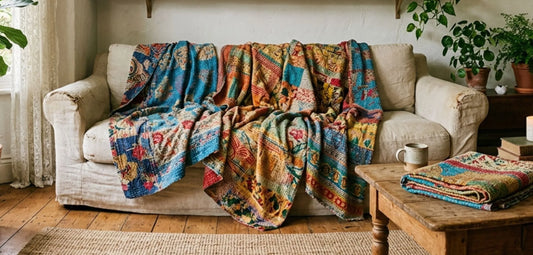
Browse our suzani jacket collection — handmade in Jaipur by artisans whose skill keeps this tradition alive — and find a piece worth wearing for that reason as much as any other. We also have suzani trousers and cotton suzani throws for those who want to bring the craft into their home as well as their wardrobe.
Also Read - What Is Hand Block Printing? The Ancient Art Behind Every Eastern Loom Piece
FAQs About Suzani Embroidery
1. Where is Eastern Loom's suzani embroidery made?
All of our suzani pieces are made by artisans based in Jaipur and the surrounding regions of Rajasthan, India. Some artisans work in shared workshops, others embroider from home. Either way, every piece is made entirely by hand by skilled craftspeople who have spent years developing their embroidery technique.
2. How long does it take to make one suzani jacket?
It depends on the density of the embroidery and the complexity of the design, but a fully embroidered suzani jacket represents many hours — sometimes days — of skilled hand work. This is one of the reasons handmade suzani pieces cost more than machine-produced alternatives, and why fair wages for that work matter.
3. Is suzani embroidery always done by women?
Traditionally, suzani was women's work — specifically bridal work passed down through female family lines. In the artisan communities Eastern Loom works with in Jaipur, the embroidery work is predominantly done by women, for whom it represents a significant and often primary source of household income.
4. What is the difference between suzani embroidery on cotton versus velvet?
The base fabric changes the feel and the occasion of the piece significantly. Cotton suzani jackets are lighter, more breathable, and versatile across seasons — a strong choice for layering in spring and autumn. Velvet suzani jackets are richer and warmer in hand, with a depth of colour and texture that makes them more of a statement piece for cooler weather. The embroidery technique is the same on both.
5. How should I care for a suzani embroidered jacket?
Hand wash gently in cool water with a mild detergent, or dry clean for velvet pieces. Do not wring or tumble dry. For cotton, dry flat in the shade. For velvet, hang to dry away from direct sunlight to preserve the pile. Iron inside out on a low setting, never directly on the embroidery. Store folded in a breathable cotton bag rather than a plastic cover.
Browse The Eastern Loom's suzani jacket collection — hand-embroidered by artisans in Jaipur, made fairly, and built to last. Also explore our suzani trousers and cotton suzani throws.
Tags:
Previous
How to Choose the Perfect Bridesmaid Getting-Ready Robe (That Photographs Beautifully)
Next
Cotton Kimono Robe vs Silk Kimono Robe — Which One Is Right for You?